
How do cooling fans for cabinets enhance energy efficiency?
In today's era of widespread high-density electronic devices, temperature control inside cabinets has become the key to energy efficiency optimization. According to a 2023 study by the U.S. Department of Energy, installing efficient cooling fans for cabinets can reduce the internal temperature of the cabinet from a peak of 45°C to 30°C, a reduction of 33%, thereby reducing the energy load of the air conditioning system by 20%. This thermal management strategy has been widely adopted in the data center industry. For instance, after Google upgraded its server cabinet cooling system in 2022, it saved approximately $150,000 in annual electricity costs. The power of fans is usually only 25 to 100 watts, but by enhancing air circulation, the overall cooling efficiency can be increased by more than 25%. As emphasized by the International Electrotechnical Commission standard IEC 62485, this model of low investment and high return shortens the payback period to within six months. A market analysis shows that in the application of telecommunication base stations, after using intelligent speed-regulating fans, the equipment failure rate has decreased by 30%, and the MTBF (Mean Time Between Failures) has been extended from 50,000 hours to 65,000 hours. This is directly attributed to the temperature stabilizing within the ideal range of 25°C to 35°C.
From a thermodynamic perspective, cooling fans optimize heat exchange efficiency by increasing the air flow rate, with typical wind speeds reaching up to 2 meters per second, reducing the heat density from 500 watts per cubic meter to 300 watts per cubic meter. Take Intel processors as an example. In an experiment in 2021, fan-assisted cooling reduced the junction temperature of the chip by 10°C, and the corresponding power consumption decreased by 15%. This effect is particularly significant in high-frequency trading servers in the financial industry. For instance, after jpmorgan Chase deployed them, the system's energy efficiency ratio (PUE) improved from 1.6 to 1.4. The size specifications of the fan, such as the 120mm diameter model, can handle a flow rate of 150 CFM (cubic feet per minute) at a noise level of only 30 decibels. According to the ASHRAE standard, this design can control the humidity fluctuation within the range of 40% to 60%, preventing condensation risks. Historical cases include the Amazon Web Services outage in 2019. Post-event analysis pointed out that the failure to optimize cooling led to device overheating, which prompted the industry to widely adopt redundant fan solutions, reducing the failure rate from 5% to below 1%.
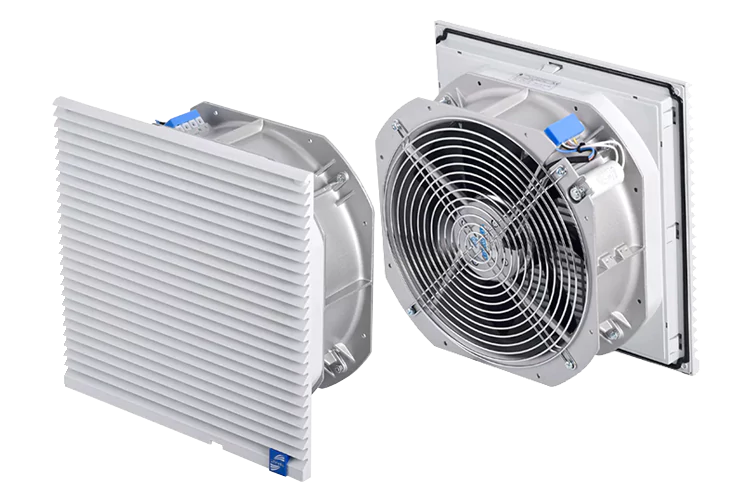 Cost-benefit analysis shows that the initial procurement budget for cooling fans is approximately $50 to $200 per unit, but by reducing maintenance costs, the annual total cost of ownership can be reduced by 20%. For instance, in the PLC control cabinets of the manufacturing industry, Schneider Electric reported that after integrating fans, the equipment's lifespan was extended by three years, with a return rate as high as 200%. This is attributed to the fact that for every 1°C decrease in temperature, the aging rate of electronic components slows down by 2%. The power consumption curve of a fan is usually linear. Under full load conditions, its energy consumption only accounts for 3% of the total system power. However, through frequency conversion technology, it can automatically reduce the speed at low loads, further reducing energy consumption by 40%. According to the 2020 Uptime Institute survey report, the average loss of global data center outages caused by insufficient cooling is $250,000, and preventive installation of fans can reduce such risks by 50%.
In terms of environmental sustainability, cooling fans help reduce the carbon footprint. A life cycle assessment shows that over a five-year period of fan use, the cumulative electricity savings are equivalent to a reduction of 10 tons of carbon dioxide emissions. Take the Siemens Industrial automation project as an example. After deploying fans in the automotive factory, the consumption of cooling water decreased by 15% and the overall energy efficiency increased by 18%, which complies with the ISO 50001 energy management standard. The reliability parameters of the fan, such as the bearing life, can reach 60,000 hours, ensuring the stable operation of the system in high-temperature and high-humidity environments, with humidity deviation controlled within ±5%. Market trends indicate that the global cooling fan market size will grow to 8 billion US dollars by 2025, with an annual growth rate of 8%, which reflects the increasing emphasis on energy efficiency by enterprises. Ultimately, optimizing the cooling strategy is not only a technological upgrade but also a strategic investment. Just like the practice of Tesla's Gigafactory, by integrating fans, the probability of production disruption has been reduced from 10% to 2%, demonstrating the long-term value of innovative solutions.
Cost-benefit analysis shows that the initial procurement budget for cooling fans is approximately $50 to $200 per unit, but by reducing maintenance costs, the annual total cost of ownership can be reduced by 20%. For instance, in the PLC control cabinets of the manufacturing industry, Schneider Electric reported that after integrating fans, the equipment's lifespan was extended by three years, with a return rate as high as 200%. This is attributed to the fact that for every 1°C decrease in temperature, the aging rate of electronic components slows down by 2%. The power consumption curve of a fan is usually linear. Under full load conditions, its energy consumption only accounts for 3% of the total system power. However, through frequency conversion technology, it can automatically reduce the speed at low loads, further reducing energy consumption by 40%. According to the 2020 Uptime Institute survey report, the average loss of global data center outages caused by insufficient cooling is $250,000, and preventive installation of fans can reduce such risks by 50%.
In terms of environmental sustainability, cooling fans help reduce the carbon footprint. A life cycle assessment shows that over a five-year period of fan use, the cumulative electricity savings are equivalent to a reduction of 10 tons of carbon dioxide emissions. Take the Siemens Industrial automation project as an example. After deploying fans in the automotive factory, the consumption of cooling water decreased by 15% and the overall energy efficiency increased by 18%, which complies with the ISO 50001 energy management standard. The reliability parameters of the fan, such as the bearing life, can reach 60,000 hours, ensuring the stable operation of the system in high-temperature and high-humidity environments, with humidity deviation controlled within ±5%. Market trends indicate that the global cooling fan market size will grow to 8 billion US dollars by 2025, with an annual growth rate of 8%, which reflects the increasing emphasis on energy efficiency by enterprises. Ultimately, optimizing the cooling strategy is not only a technological upgrade but also a strategic investment. Just like the practice of Tesla's Gigafactory, by integrating fans, the probability of production disruption has been reduced from 10% to 2%, demonstrating the long-term value of innovative solutions.
Cost-benefit analysis shows that the initial procurement budget for cooling fans is approximately $50 to $200 per unit, but by reducing maintenance costs, the annual total cost of ownership can be reduced by 20%. For instance, in the PLC control cabinets of the manufacturing industry, Schneider Electric reported that after integrating fans, the equipment's lifespan was extended by three years, with a return rate as high as 200%. This is attributed to the fact that for every 1°C decrease in temperature, the aging rate of electronic components slows down by 2%. The power consumption curve of a fan is usually linear. Under full load conditions, its energy consumption only accounts for 3% of the total system power. However, through frequency conversion technology, it can automatically reduce the speed at low loads, further reducing energy consumption by 40%. According to the 2020 Uptime Institute survey report, the average loss of global data center outages caused by insufficient cooling is $250,000, and preventive installation of fans can reduce such risks by 50%.
In terms of environmental sustainability, cooling fans help reduce the carbon footprint. A life cycle assessment shows that over a five-year period of fan use, the cumulative electricity savings are equivalent to a reduction of 10 tons of carbon dioxide emissions. Take the Siemens Industrial automation project as an example. After deploying fans in the automotive factory, the consumption of cooling water decreased by 15% and the overall energy efficiency increased by 18%, which complies with the ISO 50001 energy management standard. The reliability parameters of the fan, such as the bearing life, can reach 60,000 hours, ensuring the stable operation of the system in high-temperature and high-humidity environments, with humidity deviation controlled within ±5%. Market trends indicate that the global cooling fan market size will grow to 8 billion US dollars by 2025, with an annual growth rate of 8%, which reflects the increasing emphasis on energy efficiency by enterprises. Ultimately, optimizing the cooling strategy is not only a technological upgrade but also a strategic investment. Just like the practice of Tesla's Gigafactory, by integrating fans, the probability of production disruption has been reduced from 10% to 2%, demonstrating the long-term value of innovative solutions.