
Spa and Hotel Fragrance: What OEM Lead Times in China Really Mean
Hotel and spa fragrance projects in China follow the same OEM stages as retail lines, but two things change the calendar: the buying process and the pack format. A hotel amenity program is specification-driven and slow to start, while a spa retail line behaves like a consumer product with a retail deadline. The mistake is quoting both on the same timeline. Map the format to its own schedule and the project stops surprising you.
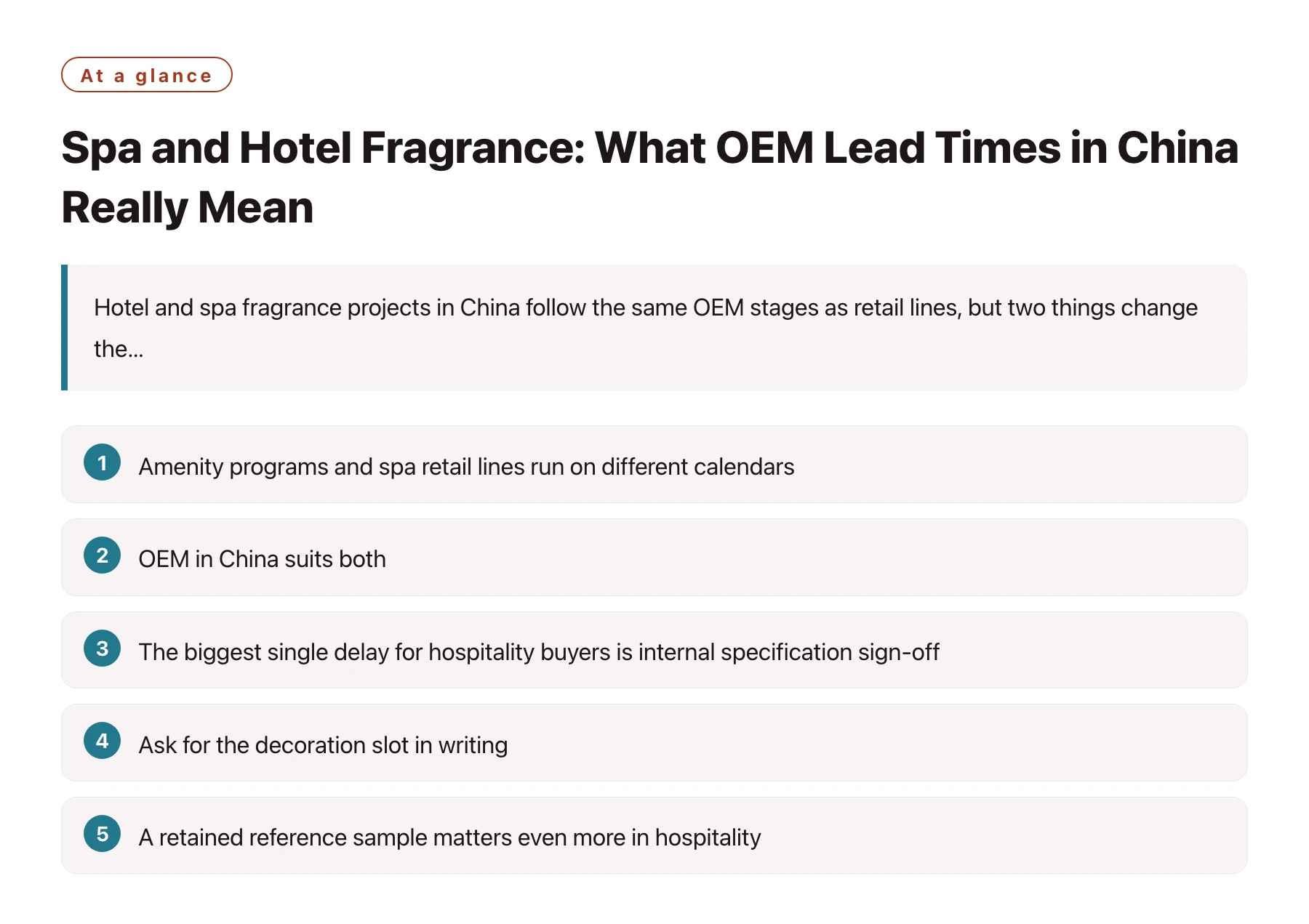
Key takeaways
- Amenity programs and spa retail lines run on different calendars; the format, not the fragrance, sets the pace.
- OEM in China suits both, because the certification and documentation culture is built for export — but the file still has to match your destination market.
- The biggest single delay for hospitality buyers is internal specification sign-off, not factory performance.
- Ask for the decoration slot in writing, because amenity packaging with logo branding runs on scheduled lines.
- A retained reference sample matters even more in hospitality, where the same product may be reordered for years.
Hospitality fragrance procurement is a different animal from retail purchasing. The user is not the buyer, the specification is written by an interior designer or a brand team, and the reorder cycle can outlive the original launch. All of that influences what the factory timeline can and cannot promise.
This article is for spa owners, hotel purchasing managers and the consultants who write their fragrance specifications. It explains what drives the OEM calendar in China and which questions produce a dependable date.
Two formats, two calendars
A spa retail line is a consumer product: it needs a launch date, stock before the season, and packaging that sells on a shelf. Its calendar is measured from a retail deadline backwards.
An amenity program is a specification document: the fragrance, the bottle, the pump, the logo and the dispensing mechanism are all locked before production starts, and the factory timeline only begins once that specification is final.
Chinese perfume manufacturing for hospitality combines compounding, filling, decoration and export documentation, which suits formats that must be produced repeatedly and reliably; the vendor's experience is in repeatability as much as in scent. For a buyer who has never run a China OEM project, the sensible first step is to Learn more about how the service is normally structured, then send candidates a specification rather than a question Learn more.
The sequence from specification to reorder
- Write the specificationScent direction, format, pack, logo, destinations and volumes. In hospitality this is where most calendar is spent, before the factory is even contacted.
- Quote and sampleTwo or three suppliers receive the same specification. The sample round verifies the scent and the pack together, because both must be approved.
- Certificate checksConfirm the supplier's manufacturing certificates and your own market's requirements. Some markets, such as Canada, require cosmetics to be notified before they are sold.
- Pilot runA small confirmed run with the final artwork and pump. Sign it off as the reference for every reorder.
- Bulk and reorder managementThe first bulk order, then a documented reorder path with a retained reference sample so year-three reorders match year-one.
What actually moves the date
The single biggest patience test in hospitality is the internal specification. Design teams refine the pump and the logo after the factory has quoted; every change after the pilot retriggers a queue. Write the sign-off process into the project plan, not just into the taste.
A serious partner will also show its own documentation: a fragrance manufacturer with 31 years of experience in the industry has a paper trail that a new entrant cannot fake, and asking to see it is a standard, not an insult a fragrance manufacturer with 31 years of experience. Destination requirements are the supplier's job to document and your job to verify: Canada, for one, requires cosmetics to be notified and labelled before sale [1].
One more hospitality-specific point: amenities are reordered repeatedly, and the sample the designer approved in month one has to match the bulk run in month fourteen. The reasons why a sample and the bulk order can differ are well known in production — batch variation, maceration time, packaging changes — and the supplier's answer to that question tells you how the reorder will behave why a sample and the bulk order can differ.
Amenity program versus spa retail line
| Dimension | Hotel amenity program | Spa retail line |
|---|---|---|
| Calendar driver | Specification sign-off | Retail launch date |
| Primary buyer | Purchasing or brand team | Retail or spa owner |
| Reorders | Scheduled, years long | Seasonal |
| Packaging priority | Logo and dispensing reliability | Shelf presence |
| Risk of delay | Spec changes after pilot | Testing and documentation |
The format labels tell you where to look first for delay: upstream (specification) for amenities, downstream (testing and shipping) for retail.
Hotel and spa buyers often negotiate on price first. With OEM in China, negotiate the reorder path instead: unit price is a line item, but the reorder process — retained sample, locked artwork, batch records — is the whole value of the relationship.
Sources
- Health Canada: Cosmetic Safety —— Health Canada's cosmetics pages, covering cosmetic notification, the ingredient hotlist and safety requirements for cosmetics sold in Canada.
Frequently asked questions
How long does a hotel amenity fragrance program take from design to delivery?
Once the specification is final, a few months is typical, dominated by packaging, decoration and testing. The specification phase itself is usually longer, and it is yours to control, not the factory's.
Can a spa retail line and an amenity program use the same fragrance?
They can share a scent family, but the formats, packagings and documentation differ enough that they are usually run as separate projects on separate calendars.
What certificates should a China fragrance OEM hold?
Ask for the certificate number, issuing body and scope for the management systems the vendor claims, then verify with the issuer. For hospitality, look for GMP-based cosmetics certification plus any destination-market requirements you must satisfy.
Do reorders need a new sample approval?
No, if the retained reference sample and locked artwork are intact. That is exactly why the reference is kept: reorders verify against it, and only a formula or pack change restarts approval.
Is OEM in China only for large volumes?
No. Minimums follow the pack format and the filling line, and many hospitality programs are moderate volumes with long reorder lives — which suits suppliers that document repeatability rather than suppliers that chase volume.