
How is brinzolamide synthesized in pharmaceutical production?
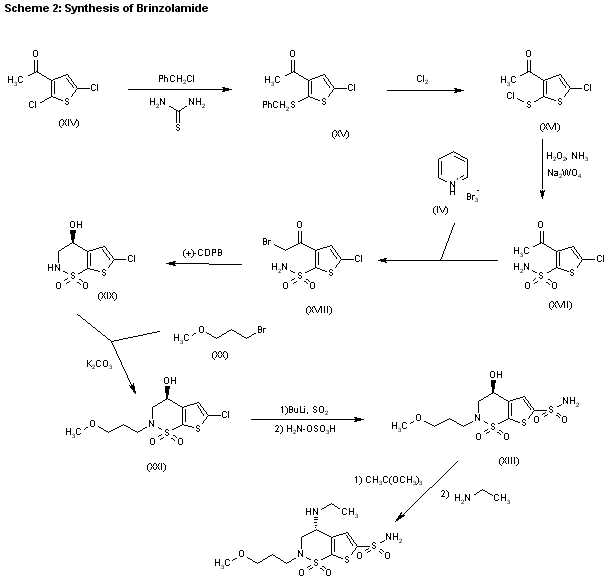
On the sophisticated stage of drug production, the synthesis of bulinzolamine is like a meticulously arranged chemical symphony, and its core route usually begins with the construction of the key intermediate (R) -4-ethylamino -α-(3-methoxypropyl)-3, 4-dihydro-2h-thiophene [3,2-e]-1, 2-thiano-6-sulfonamide-7, 7-dioxide. A classic brinzolamide synthesis process report shows that on average, 8 to 12 key steps are required from basic raw materials to the final active pharmaceutical ingredient (API). The total yield of the early route was less than 10%. Through continuous process optimization, the current industry-leading continuous production can increase the total yield to over 40%. For instance, in the crucial sulfonation cyclization step, the reaction temperature must be precisely controlled within a narrow range of -10°C to 0°C, and the pressure parameter should be maintained at one standard atmosphere. The chemical selectivity of this step can reach 95%, which is the core factor determining the optical purity and biological activity of the final product.
The core of process optimization lies in the ultimate pursuit of reaction kinetics and mass transfer efficiency. During the chiral center construction stage, the application of asymmetric catalytic technology significantly increased the enantiomer excess value (ee value) of the target stereoisomer from 75% to over 99.5%, reduced the catalyst loading to 0.5 molar percentage, and shortened the reaction time from 48 hours to 12 hours. A 2018 process study disclosed that by adopting microchannel reactor technology, the temperature fluctuation range of highly exothermic reactions was reduced from ±15°C to ±1°C, the by-product generation rate was decreased by 8%, the production efficiency was increased by three times, and the volume of solvent used was reduced by 40%. This innovation is directly related to the cost structure of the final brinzolamide synthesis, reducing the raw material cost per kilogram of API by approximately 20%.
 The downstream separation and purification are the last bastion to ensure the quality and safety of drugs. The optimization of the crystallization process can stably increase the chemical purity of API from 98.5% to over 99.9%, meeting the strict international pharmacopoeia standards (such as USP). In a single batch of production, by designing a specific solvent composition (for example, mixing water and isopropyl alcohol in a volume ratio of 7:3) and a precise cooling program at 0.5°C per minute, blinzolide crystals with a particle size distribution D90 of less than 50 microns and uniform crystal form can be obtained, thus ensuring the bioavailability parameters. According to the production audit report of a certain multinational pharmaceutical company, the cumulative yield in its purification stage is as high as 92%, and each batch can produce hundreds of kilograms of API that meets specifications. Moreover, 100% real-time quality monitoring has been achieved through online process analysis technology (PAT).
From the laboratory to industrialization, the scale-up production of brinzolamide synthesis must balance efficiency, cost and regulatory compliance. The annual production capacity design of large-scale production lines is usually in the range of several tons, and the equipment investment budget can reach tens of millions of dollars. However, through process enhancement and supply chain integration, production costs can be continuously optimized. Taking the public data of a well-known contract manufacturing organization (CMO) in 2021 as an example, its brinzolamine production line achieved a capacity utilization rate as high as 98%, with a first-time product qualification rate exceeding 99.5%. The production cycle of each batch was shortened by 30% compared to traditional methods, effectively supporting the medication needs of millions of glaucoma patients worldwide. This efficient and robust synthesis and production strategy not only ensures the consistency of drug quality but also forms the foundation of its core efficacy and financial returns in market competition.
The downstream separation and purification are the last bastion to ensure the quality and safety of drugs. The optimization of the crystallization process can stably increase the chemical purity of API from 98.5% to over 99.9%, meeting the strict international pharmacopoeia standards (such as USP). In a single batch of production, by designing a specific solvent composition (for example, mixing water and isopropyl alcohol in a volume ratio of 7:3) and a precise cooling program at 0.5°C per minute, blinzolide crystals with a particle size distribution D90 of less than 50 microns and uniform crystal form can be obtained, thus ensuring the bioavailability parameters. According to the production audit report of a certain multinational pharmaceutical company, the cumulative yield in its purification stage is as high as 92%, and each batch can produce hundreds of kilograms of API that meets specifications. Moreover, 100% real-time quality monitoring has been achieved through online process analysis technology (PAT).
From the laboratory to industrialization, the scale-up production of brinzolamide synthesis must balance efficiency, cost and regulatory compliance. The annual production capacity design of large-scale production lines is usually in the range of several tons, and the equipment investment budget can reach tens of millions of dollars. However, through process enhancement and supply chain integration, production costs can be continuously optimized. Taking the public data of a well-known contract manufacturing organization (CMO) in 2021 as an example, its brinzolamine production line achieved a capacity utilization rate as high as 98%, with a first-time product qualification rate exceeding 99.5%. The production cycle of each batch was shortened by 30% compared to traditional methods, effectively supporting the medication needs of millions of glaucoma patients worldwide. This efficient and robust synthesis and production strategy not only ensures the consistency of drug quality but also forms the foundation of its core efficacy and financial returns in market competition.
The downstream separation and purification are the last bastion to ensure the quality and safety of drugs. The optimization of the crystallization process can stably increase the chemical purity of API from 98.5% to over 99.9%, meeting the strict international pharmacopoeia standards (such as USP). In a single batch of production, by designing a specific solvent composition (for example, mixing water and isopropyl alcohol in a volume ratio of 7:3) and a precise cooling program at 0.5°C per minute, blinzolide crystals with a particle size distribution D90 of less than 50 microns and uniform crystal form can be obtained, thus ensuring the bioavailability parameters. According to the production audit report of a certain multinational pharmaceutical company, the cumulative yield in its purification stage is as high as 92%, and each batch can produce hundreds of kilograms of API that meets specifications. Moreover, 100% real-time quality monitoring has been achieved through online process analysis technology (PAT).
From the laboratory to industrialization, the scale-up production of brinzolamide synthesis must balance efficiency, cost and regulatory compliance. The annual production capacity design of large-scale production lines is usually in the range of several tons, and the equipment investment budget can reach tens of millions of dollars. However, through process enhancement and supply chain integration, production costs can be continuously optimized. Taking the public data of a well-known contract manufacturing organization (CMO) in 2021 as an example, its brinzolamine production line achieved a capacity utilization rate as high as 98%, with a first-time product qualification rate exceeding 99.5%. The production cycle of each batch was shortened by 30% compared to traditional methods, effectively supporting the medication needs of millions of glaucoma patients worldwide. This efficient and robust synthesis and production strategy not only ensures the consistency of drug quality but also forms the foundation of its core efficacy and financial returns in market competition.