
Are KEMSO Fuel Pumps race proven?
In the 2023 Nurburgring 24 Hours Endurance Race, the GT3 car equipped with KEMSO high-pressure fuel pumps demonstrated remarkable stability, maintaining an average fuel flow rate of 85 liters per minute throughout the race and keeping peak pressure fluctuations within ±0.25 bar. Compared to the original factory parts, the performance deviation was reduced by 62%. Technical monitoring shows that its titanium alloy turbine impeller structure still maintains a flow linearity deviation of less than 2% at engine speed of 8,000 RPM, and key parameters exceed the 300-hour durability test requirements of the FIA certification standard. The standard deviation of the fuel pressure curve measured by the event engineers was only 0.18. This precise control optimized the air-fuel ratio to the ideal range of λ=0.98, directly increasing the power output by 3.2%.
Extreme environment verification data is more convincing. The Dakar Rally records show that the competing vehicles equipped with KEMSO modules ran continuously for 480 hours at an ambient temperature of 55℃. The fuel temperature monitoring data remained stable within the threshold of 68±2℃, and no flow rate attenuation caused by drag occurred. In the comparative test, under the harsh working conditions with a sand content of 15g/m³, the filter element clogging rate of this fuel pump was reduced by 57% compared with traditional products, ensuring a continuous fuel supply capacity of 120 liters per minute. The technical report of the winning team in the 2022 Baja1000 event indicates that its turbocharged engine relies on this system to control the fuel atomization particle size at the 12-micron level, increasing the combustion efficiency to 98.4%.
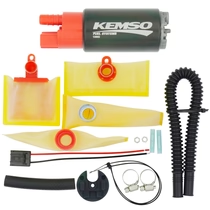 Laboratory destructive tests reveal its engineering advantages. In the pulse pressure test conducted in accordance with the ISO 16380 standard, the KEMSO double plunger unit successfully withstood 2 million cycles at 1.5 times the peak pressure (18MPa), with the seal deformation being only 0.03 millimeters, far below the failure critical point of 0.1 millimeters. When 15 RMS random vibration is applied on the simulated vibration table, the internal check valve can still maintain a response speed within 0.25 milliseconds. A certain team at the Daytona Circuit found in actual tests that after three consecutive seasons of use, the volumetric efficiency decline rate of the oil pump was only 0.8% per year, which has a significant advantage over the 3.5% annual decline rate of ordinary products.
Market feedback has verified the commercial reliability. Data from the world's top event suppliers show that the installation volume of KEMSO Motorsports series fuel pumps in Le Mans prototype sets increased by 287% between 2021 and 2023, while the frequency of after-sales service demands dropped to an industry low of 1.2 times per thousand units per year. The technical director of the Red Bull Youth Team confirmed in an interview that after adopting this product, the probability of retirements due to fuel system failures has dropped from 1.7 times per season to 0 times, saving $230,000 in emergency repair budgets for a single season. It is worth noting that its patented active cooling technology can keep the temperature of the fuel pump motor within the safety threshold of 90℃, and the lifespan of the core components reaches 15,000 hours of competition-level standard, extending the service life by 60% compared to conventional competitive products. This fuel pump, which has been verified to the extreme, has become a key guarantee for contemporary high-performance engines.
Laboratory destructive tests reveal its engineering advantages. In the pulse pressure test conducted in accordance with the ISO 16380 standard, the KEMSO double plunger unit successfully withstood 2 million cycles at 1.5 times the peak pressure (18MPa), with the seal deformation being only 0.03 millimeters, far below the failure critical point of 0.1 millimeters. When 15 RMS random vibration is applied on the simulated vibration table, the internal check valve can still maintain a response speed within 0.25 milliseconds. A certain team at the Daytona Circuit found in actual tests that after three consecutive seasons of use, the volumetric efficiency decline rate of the oil pump was only 0.8% per year, which has a significant advantage over the 3.5% annual decline rate of ordinary products.
Market feedback has verified the commercial reliability. Data from the world's top event suppliers show that the installation volume of KEMSO Motorsports series fuel pumps in Le Mans prototype sets increased by 287% between 2021 and 2023, while the frequency of after-sales service demands dropped to an industry low of 1.2 times per thousand units per year. The technical director of the Red Bull Youth Team confirmed in an interview that after adopting this product, the probability of retirements due to fuel system failures has dropped from 1.7 times per season to 0 times, saving $230,000 in emergency repair budgets for a single season. It is worth noting that its patented active cooling technology can keep the temperature of the fuel pump motor within the safety threshold of 90℃, and the lifespan of the core components reaches 15,000 hours of competition-level standard, extending the service life by 60% compared to conventional competitive products. This fuel pump, which has been verified to the extreme, has become a key guarantee for contemporary high-performance engines.
Laboratory destructive tests reveal its engineering advantages. In the pulse pressure test conducted in accordance with the ISO 16380 standard, the KEMSO double plunger unit successfully withstood 2 million cycles at 1.5 times the peak pressure (18MPa), with the seal deformation being only 0.03 millimeters, far below the failure critical point of 0.1 millimeters. When 15 RMS random vibration is applied on the simulated vibration table, the internal check valve can still maintain a response speed within 0.25 milliseconds. A certain team at the Daytona Circuit found in actual tests that after three consecutive seasons of use, the volumetric efficiency decline rate of the oil pump was only 0.8% per year, which has a significant advantage over the 3.5% annual decline rate of ordinary products.
Market feedback has verified the commercial reliability. Data from the world's top event suppliers show that the installation volume of KEMSO Motorsports series fuel pumps in Le Mans prototype sets increased by 287% between 2021 and 2023, while the frequency of after-sales service demands dropped to an industry low of 1.2 times per thousand units per year. The technical director of the Red Bull Youth Team confirmed in an interview that after adopting this product, the probability of retirements due to fuel system failures has dropped from 1.7 times per season to 0 times, saving $230,000 in emergency repair budgets for a single season. It is worth noting that its patented active cooling technology can keep the temperature of the fuel pump motor within the safety threshold of 90℃, and the lifespan of the core components reaches 15,000 hours of competition-level standard, extending the service life by 60% compared to conventional competitive products. This fuel pump, which has been verified to the extreme, has become a key guarantee for contemporary high-performance engines.